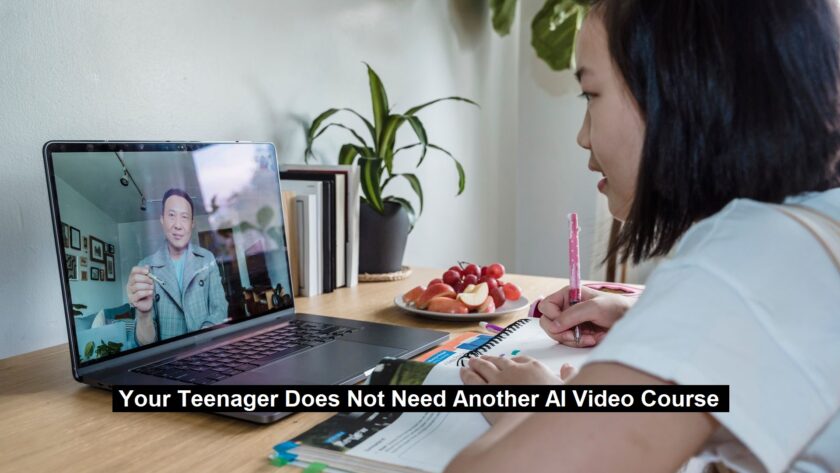
There is a specific kind of parent panic about artificial intelligence right now, and it usually ends with a teenager watching a ten hour tutorial series on a Saturday. The intentions are good. The result is often a kid who can define a large language model and still cannot build a single thing with one.
This is not the teenager’s fault, and it is not the tutorial’s fault either. It is a mismatch between how we teach a fast moving skill and how that skill actually gets learned. Watching someone else build is comfortable. It feels like progress. It is also the slowest way to end up with something you can do on your own.
Watching Is Not Building
Ask any teacher what separates a student who understands a subject from one who only recognizes it. The answer is almost always the same. The first student can make something. The second can nod along. AI has widened that gap, because the tools look easy in a demo and turn out to be full of small decisions the demo skipped.
A student who has only watched videos knows the words. A student who has built a working project has hit the wall where the model returns nonsense, figured out why, and fixed it. That second experience is the one that sticks, because it was earned. It is also the one a college reviewer or a first employer can actually see.
Here is the uncomfortable part for the video course model. Completion is not competence. A certificate says a student finished the material. It says nothing about whether they can start from a blank screen and produce a result. Admissions officers and hiring managers worked this out a while ago, which is why a portfolio of real work now carries more weight than a stack of course badges.
Read: How to Ace Job Interviews with the Right Education and Preparation
What Colleges and Employers Actually Check
Talk to people who read applications for a living and a pattern shows up fast. They are not moved by how many courses a student took. They are moved by one thing the student built, especially if the student can explain the choices behind it. A real project answers the only question that matters. Can this person do the work, or do they just know the vocabulary?
That is why the shape of a course matters as much as its content. A course that ends in a video you watched leaves you with a memory. A course that ends in a shipped project leaves you with proof, a real link or demo you can send to anyone. One of those travels with a student into an application or an interview. The other stays behind.
This is the gap a handful of newer programs are built to close. D’SKILLS runs self-paced AI courses for high school students where every course ends in a real project rather than a certificate. A student picks a problem worth solving, works through short guided lessons, ships something live, and keeps the finished build as a portfolio piece. The company reports that about 90 percent of learners ship portfolio work within their first month, which is the number that actually counts, because a project nobody finishes helps nobody.
Why Project First Changes the Student

Something changes in a student when the goal is a finished thing instead of a finished playlist. The lessons stop being the point and become the means. A teenager building a custom AI assistant that answers from real data is not memorizing terms. They are making a hundred small decisions, and every one of them teaches more than a quiz ever could.
It also changes how they talk about their work, which is half the battle in any application. A student who built something can walk you through it, tell you what broke, and explain what they would do differently. That fluency cannot be faked, and it is exactly what an interviewer is listening for. Confidence that comes from having done the thing sounds different from confidence that comes from having watched it.
There is a practical benefit for parents too. A project based course has a visible finish line. You are not left wondering whether the money bought anything, because at the end there is a link, a demo, a case study, something your teenager made and can show at the dinner table. Progress you can see beats progress you have to take on faith.
The Skill Worth Teaching
None of this means videos are useless. They are fine for a first look at an idea. The mistake is treating passive content as the whole education when it is really the warm up. The teenager who will do well in an AI shaped world is not the one who watched the most. It is the one who built the most, and who has the finished work to prove it.
So before signing a teenager up for another tutorial marathon, it is worth asking a simpler question. At the end of this, what will they have made? If the honest answer is nothing, the course was entertainment. If the answer is a real project they can show and explain, that is the one worth their Saturday. Watching teaches recognition. Building teaches skill. Pick the one that leaves something behind.